20 October 2026
Why British racing green is green: a short history
British racing green began with a green Napier in 1902 and a race held in Ireland in 1903. A short history of the colour, and of the fragrance that borrowed its name.
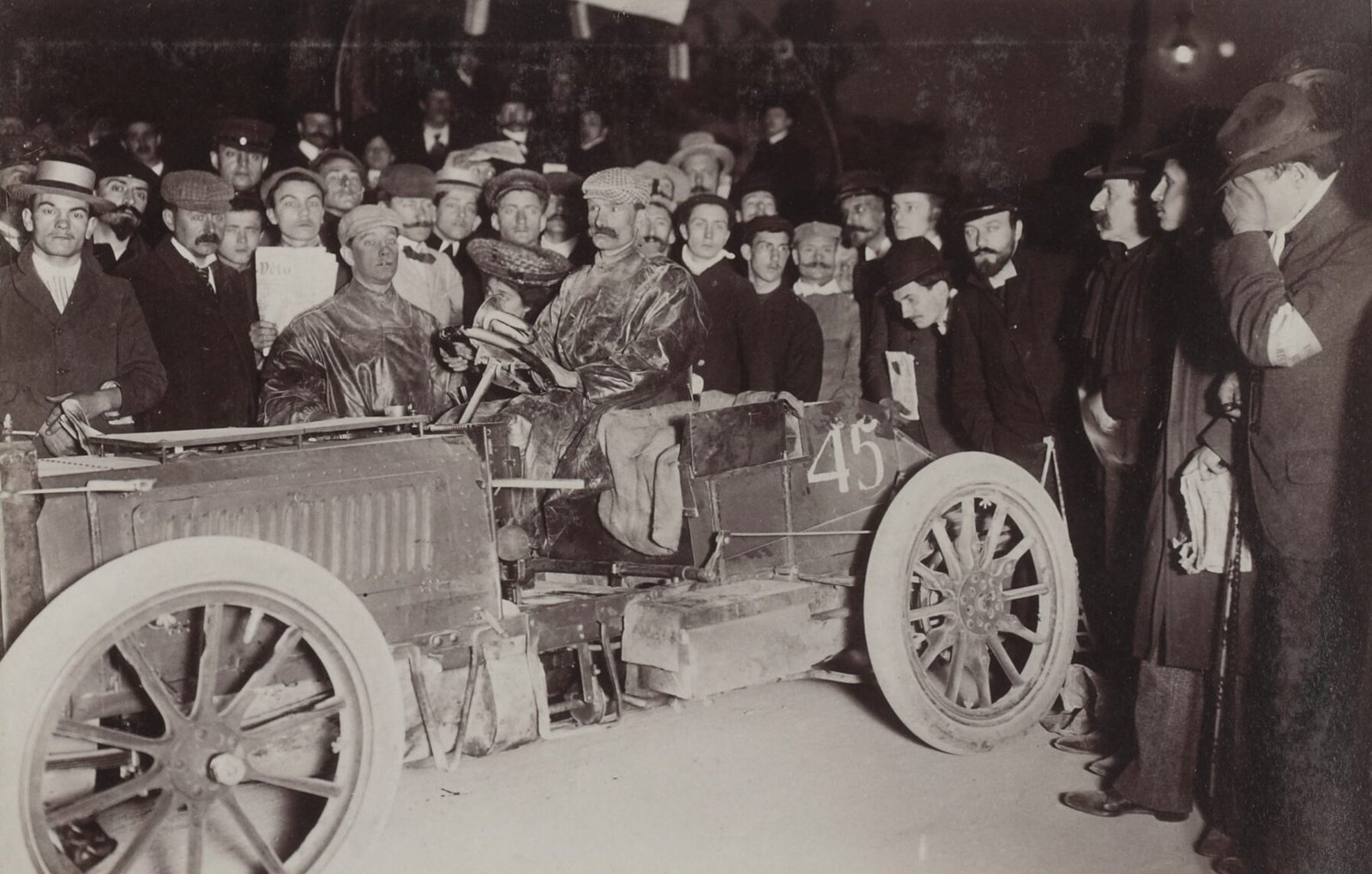
Ask why British racing green is green and you will usually be told something about Ireland. That is true, as far as it goes. But the colour was already on a British car a year before the Irish race, and the full story is a small lesson in how traditions are made: partly by accident, partly by good manners and then by everyone agreeing not to change them.
Racing in national colours
At the turn of the last century one of the most important motor races in the world was the Gordon Bennett Cup. Its trophy was put up by James Gordon Bennett Jr., the American owner of the New York Herald, and it was first contested in France in 1900.
The Cup was a contest between nations rather than makers. Each country’s club entered a small team, and the cars had to be built in the country they represented. A Leinster newspaper put it plainly in 1903: the cars “must be the absolute production of their respective nationalities”. Since the race was really a test of national industry, it made sense for spectators to tell the nations apart at a glance, and so each was given a colour.
Britain came late to the arrangement and, as the story is usually told, by the time it entered the obvious choices were spoken for. Red, white and blue, the colours of the British flag, had already gone to the United States, Germany and France. Britain needed something else.
1902: a green Napier wins the Gordon Bennett Cup
The 1902 Cup was run from Paris to Innsbruck, alongside the great Paris to Vienna race, over about 350 miles of public road. Britain’s hopes rested on Selwyn Edge and a Napier, with a riding mechanic beside him.
The French cars were faster, and they all fell out. Edge’s Napier was the only car to finish, in a little over eleven hours, at an average of under 32 miles an hour. It was not a glamorous win, but it was a win, and it was Britain’s first in the Cup.
The Napier was green. Accounts of the shade differ: some describe it as olive, others as dark green. The Napier Power Heritage Trust, which keeps the company’s history, says the car earned the title “First to Wear the Green”. Why it was green is less settled, and sources differ. The Trust puts it down to a tribute to Ireland; other accounts say green was simply Napier’s own colour, chosen before anyone knew where the next race would be held. Either way, the colour was on a British racing car a year before the Irish race.
1903: the race goes to Ireland
Under the rules, the winning nation hosted the next race. That was a problem. Racing on public roads was not allowed in Britain, and nobody had built a circuit. The Automobile Club of Great Britain and Ireland looked instead to Ireland, then part of the United Kingdom, where a long circuit of roads in County Kildare and its neighbours was judged suitable.
Parliament still had to agree. In the spring of 1903 it passed the Light Locomotives (Ireland) Act, a short statute authorising motor races on Irish roads. On 2 July 1903 the cars raced on the Athy circuit, a figure of eight of closed roads through Kildare, Queen’s County and Carlow.
Green, in compliment to Ireland
This is where the Irish part of the story comes in, and for once there is a contemporary source for it. In April 1903 the Leinster Leader told its readers what to look for on race day: German cars in white, French in blue, American in red, and the English cars “painted green in compliment to Ireland”.
The British team that year was three Napiers, driven by Edge, Charles Jarrott and J. W. Stocks. The green they wore was, the story goes, a deeper shamrock shade than the 1902 car, chosen to honour the hosts. Whatever the exact tint, green had now been worn by British cars twice, once perhaps by chance and once by courtesy, and that was enough to make it a habit.
The Napiers did not win. Jarrott and Stocks both failed to finish, and Edge finished but was disqualified for receiving a push start. The race went to the Belgian Camille Jenatzy, driving a Mercedes for Germany, at an average of a little over 49 miles an hour. The colour outlasted the result.
What colour is British racing green?
There has never been one official shade. British racing cars have worn greens from pale olive to something close to black, and the deep bottle green most people picture now came later. Every maker mixed its own, and so did every restorer since.
Perhaps that is the most British thing about it. Nobody set out to design a national colour. It arrived because the better colours were taken, stayed because it was polite, and darkened over the decades the way a good jacket does. By the time anyone thought to write it down, everyone already knew what it meant.
Why the colour stuck
We like to think green suited the cars. It looked well on long bonnets and wire wheels, and it suited the places they raced: hedges, paddocks, grass verges and wet tarmac under a grey sky. A blue car at Brooklands looked like a visitor. A green one looked as if it had always been there.
British racing green, in a bottle
We named our signature fragrance Racing Green, and it is a green chypre. Its memory is the paddock at first light: cut grass still wet with dew, an engine warming in the cold, and a motor car older than anyone who will drive it today.
The notes follow that morning. It opens with galbanum, bergamot and cut grass, sharp and green. The heart is violet leaf, vetiver and clary sage, earthy and a little metallic. The base is saddle leather, oakmoss and cedarwood, the leather of a steering wheel that has seen fifty summers. It is best on cool mornings, on wool and waxed cotton.
Its colour, if a fragrance can have one, is the colour of those early cars: green that has been out in the weather. If the smell of a wet paddock interests you, our note on petrichor and the smell of rain explains why grass and earth smell as they do after a shower.
And if you would rather wear it beside the other five before deciding, The Discovery Set opens with our first pre-orders: six fragrances in 2 ml atomisers, one for each day of the week, with Sunday off.
A colour chosen by courtesy
The early motorists could have chosen anything. They took the colour that was left, kept it out of courtesy to their hosts, and more than a hundred and twenty years later it is still the colour people mean when they say a car looks English. It is not a bad model for a house: begin with what you have, behave well and let time do the rest.
Racing Green is the house signature. If you would like a say in which three of the six are made first, register free for a founding place; it commits you to nothing.